The letter went on in her trembling hand. My mother, Ana, had bought a small house before she died and put it in my name, with my grandmother as its guardian until I turned twenty-five. Gloria had come with a notary and a stack of papers, asking Elena to sign it over “for safekeeping.” Elena refused three times. The next week she was moved into that yellow room, and the gold earrings she wore every day vanished from her dresser. I read the last line beside the window, the yarn doll warm in my lap, and understood that her silence had never been forgetfulness. It had been a wall she built around me.
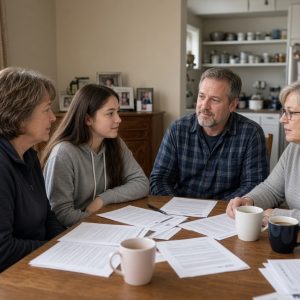
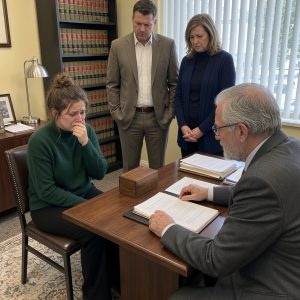
Teresa gave me the name of a legal aid attorney, Mr. Salinas, who confirmed everything within a week. The deed was real, and Gloria had filed a petition declaring my grandmother incompetent, so that a signature could be taken from her instead. My father had agreed to the move believing it was temporary. He stopped visiting because he could not face what he had allowed. I did not shout at him. I laid the photograph beside the receipts and told him I was not asking him to defend himself, only to sign the papers that ended the petition. He sat with his head in his hands for a long time. Then he signed.
Through the attorney, the earrings came back in a small envelope. Gloria never said sorry, and I stopped waiting for it. In April, I carried my grandmother’s few things into my mother’s little house, where the kitchen still held a faint smell of cinnamon, though no one had cooked there in years. I braided her white hair that first night, the way she once braided mine. She touched the earrings, then my wrist, and said I was eating enough now. We laughed until she had to wipe her eyes.
I graduated that spring. My grandmother sat in the front row in her brown shawl, the yarn doll in her lap. My father stood at the very back, hat in his hands, until she turned and waved him forward. He walked the whole aisle slowly, like a man crossing a river. She made room beside her without a word. When they called my name, I did not lower my head to anyone, and for once, nobody had to tell me who paid for it.