I reached Louisville before dawn and found Mason asleep on a police station bench, his gloves tucked inside the electric shoe dryer he refused to leave behind. The officer showed me what he had pieced together. Trevor had canceled Mason’s Savannah ticket in April, weeks before my mother died, and told no one. The cheerful texts I had treasured were scripted. Trevor had dictated every line over Mason’s shoulder, then left him a house key, a stack of frozen dinners, and instructions to say everything was fine. I had been comforted by words my son was told to type.
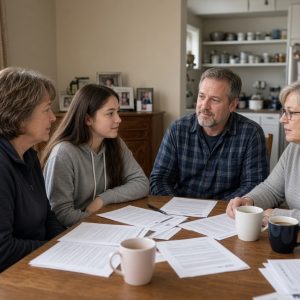
By afternoon, I had gathered everything on a folder: the canceled ticket, the screenshots, the supermarket manager’s statement, and the summons. Trevor came home from the beach on the sixth evening, sunburned and loud, with the children and their souvenirs. He stopped at the sight of the patrol car and demanded to know why police were there. I said nothing. I laid the papers on the kitchen table and let them speak. Trevor reached for excuses, then found none. He said Mason was old enough to manage, and that I had been exaggerating for years.
Then Caleb, standing at the refrigerator, pulled down a small yellow note in Mason’s careful handwriting. It said, “Dad said I can’t come. Please don’t be mad at Mom.” Caleb read it aloud, slowly, and turned to his father. Trevor had told both children that Mason chose to stay behind with a neighbor. Brooke began to cry. Caleb asked the question I never had to ask, which was why Mason always got the shoe dryer while he got the bicycle. Trevor had no answer. Their mother arrived two days later to take them home.
The court granted me full custody of Mason and ordered Trevor into supervised visits and parenting classes. I did not hate him, though I stopped explaining myself. In the autumn, I drove Mason to a quiet lake and bought him his own fishing rod. We caught nothing and laughed anyway, our sneakers soaked through. I learned that a mother’s duty is not to keep peace, but to notice, and that a child who is finally believed will tell the truth without being asked.