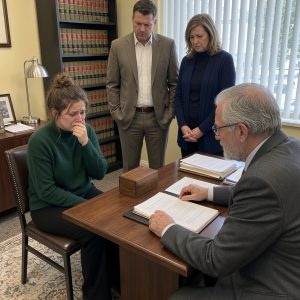
Leonard read the amendment aloud, slowly. Eighteen months before he died, Gerald had moved the lake house and its land into a trust and named me sole owner, with Marianne permitted to live there only while she treated me as family. The deed was recorded, notarized, and impossible to undo. In the cedar box lay a brass key and a short letter in Gerald’s slanted hand: “You were never a stray, Nora. You were the one I chose.” Leonard drove with me to the lake the next afternoon, because Gerald had asked that someone honest be present.
Marianne’s attorney, Mr. Pruitt, was already in the dining room with the loan papers spread out, and Trevor sat beside him, sweating. When Leonard set the deed on the table, Mr. Pruitt read the first page and went still. “Wait,” he said quietly, “she owns this?” I answered that I did, and that the signature on the bank’s collateral request was one I would never give. I kept the same tone I use on a job site, calm and clear. Marianne began to speak, but the words had nowhere to land.
I did not evict anyone that day. I told Marianne she could stay for ninety days under written terms: respect in the house, no more speaking about me as if I were absent, and no further use of my name on Trevor’s debts. Leonard drafted the notice. Brooke cried in the kitchen, then asked, in a small voice, whether she had ever treated me as a sister. I said honestly that she had not, but that it was not too late to start. Trevor’s loan collapsed on its own, as it always would have, and the bank never touched my name.
Marianne left in the spring, quietly, with nothing to announce. Brooke visited later and brought coffee, and we sat on the dock without saying much. I hung Gerald’s old fishing jacket by the door and set my duffel bag in the closet at last. That evening I stood on the porch and watched the water go dark, and I finally understood what my father had meant. I was never charity. I was family, and now I was home.