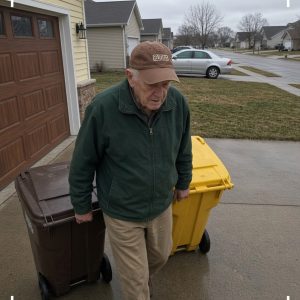
The man introduced himself as Arthur Whitfield and asked for the invoice, the work order, and the cooling hose, in that order. I laid them on the counter beside the coffee machine. He read every line, turned the split hose over in his weathered hands, and noted the stamp in the corner, 6:23 p.m., the hour I should have been home with Maisie. Then he told me the silver SUV belonged to the fleet of the company he founded. Its overheating alert, my repair record, and his daughter’s written refusal to pay had all landed in his accounts review that same night.
Eleanor had told her assistant I was padding the bill and asked the company to dispute it. Arthur had started his own career under a lift in a garage not much bigger than mine, and he knew exactly what $237 looked like for a thermostat, a hose, and an evening of a man’s time. “That is cheap,” he said quietly. “She knows it, too.” Eleanor arrived twenty minutes later with her sunglasses off. She stood among my crew, who kept their eyes on their wrenches. Her father did not raise his voice. He only asked her to read the invoice aloud, line by line.
Her voice thinned at the labor line. Then she looked at me and said she had judged a stranger by his cracked chairs and his stained shirt, and that she was sorry, to me and to everyone who had heard her. I did not make it easy, and I did not make it cruel. I told her the number had never been the point. The point was a room that went silent while my crew watched me be called a cheat. She paid in full. She tried to add a tip, and I slid it back across the counter.
Arthur offered me the fleet’s repair contract before he left. I told him I would think about it, because I wanted work that came with respect, and a week later I said yes on fair terms. The vinyl chairs stayed, and so did the rough coffee machine. That night, I took Maisie’s note out of my wallet, read it again, and pinned it above the curled corner of the calendar. Things always get better, she had written. Some days the quiet in a garage is just closing time. That evening, it felt like peace.