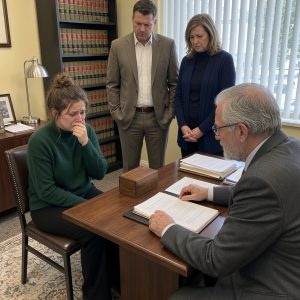
I set Grandma’s green ledger on the tablecloth, and on top of it, a stamped copy of the trust certificate, dated 9:17 that morning. “There’s nothing left to sign,” I said. “It’s irrevocable. Nobody can touch it, including me.” The notary quietly closed her canvas bag. Mom stared at the certificate as though it were written in another language. Page by page, the ledger told its own story, every transfer in Grandma’s careful hand, beginning with the $1,900 I had moved at seventeen. Beneath the last entry was a line she had written for me years ago: “To remember, not to collect.”
Margaret asked how I could do this to my own family. I asked her about the third-quarter statement, the one that vanished from Grandma’s desk, and she answered that she only wanted to be prepared. Dad looked at his hands. Colton, quietly, asked whether the truck had ever been real. I told him I would pay his tuition directly to the school, and that I would sit with him whenever he wanted to learn how money actually works. Beatrice reached across the table and pressed my fingers once, and that was all the applause I needed.
That night I drove home with the window down, thinking about the hospital room, the yellow pencil, and Grandma reading every line with her glasses low on her nose. She had not trusted my mother, but she had trusted me to learn how to read. She had left me the money, but the real inheritance was that single sentence, then decide. I understood, finally, that locking the trust had never been about fear. It was about building one place where no argument, no guilt, and no folder could ever follow me.
Months later, Margaret mailed a short letter. She did not apologize well, but she did not ask for anything, which was new. Colton enrolled in a trade program, and I paid every invoice myself, to the school, line by line. In spring, he drove up in a used truck he had bought with his own savings and asked me to read the contract before he signed. I sat down, took the pencil, and read it slowly from the front.