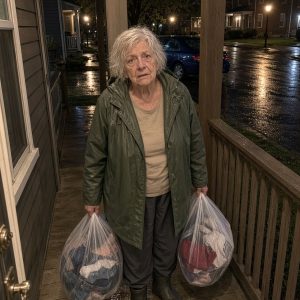
The man’s name was Wendell. He was Callum’s business partner and, I understood quickly, his oldest friend. He stood on my porch and explained what he knew, which was not everything, because Callum had kept parts of it private even from the people closest to him.
After that afternoon on the sidewalk, Callum had kept the jacket for years. He wore it until it fell apart and then he folded what remained of it and kept the patch, the red sailboat, separately. He said later, to Wendell, that it was the first time a stranger had sat down beside him. Not handed him something and walked on. Sat down.
He got sober two years after that sidewalk. He had a gift for numbers that nobody had ever asked him to use, and a woman at a halfway house helped him into a community college, and from there the story moves the way some stories do when a person finally has solid ground beneath them. He built a financial services firm. It took fifteen years and it was not easy and Wendell told me that Callum kept a torn piece of bus schedule in his desk the whole time, my name in his own handwriting, because he had promised.
He found me through a church directory, my married name, three months ago.
He did not come to the door himself because he died six weeks before Wendell arrived on my porch.
A heart attack. He was forty-seven.
The box held the sailboat patch, still intact, wrapped in tissue. Beneath it was a letter in Callum’s handwriting, dated the week before he died, explaining what that afternoon had meant and asking me to forgive the delay in keeping his promise. And beneath the letter was a cashier’s check that I will not describe in full except to say that it was not a gesture. It was a life’s worth of gratitude made tangible, and it was enough to change things for my family in ways I am still learning to accept.
I stood on my own porch and cried while Wendell waited quietly, the way you wait beside someone when there is nothing useful left to say.
I asked him whether Callum had a family.
He said yes. A wife, two daughters, a community of people who loved him.
I asked whether they knew about me.
Wendell said yes. He said Callum had told his daughters the story many times. The woman on the sidewalk who sat down. Who gave him her last ten dollars and her dead son’s name. Who made him feel, for the first time in years, that he was worth sitting beside.
I think about that sometimes, about how little I thought I was giving. A ten-dollar bill and twenty minutes. How it is possible to change the entire direction of a life without knowing you are doing it, simply by choosing not to walk past.
The jacket patch is on my kitchen windowsill now, next to a photograph of Emmett. Two things I thought were gone for good, returned on the same afternoon by a man I only met once, who kept a promise for twenty-six years because someone sat down beside him when he had nothing.
I hope he knew, before the end, that the sitting down mattered more than the money. I should have told him sooner. I will spend the rest of my life grateful he sent someone so I could finally say it, even if only to a room that was almost empty.