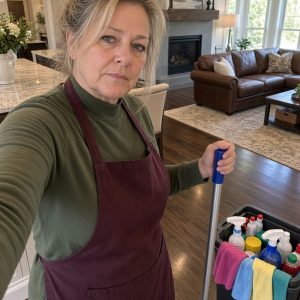
I said, “Of course,” and tied the apron at my waist, the way my mother taught me to tie everything, firmly and without fuss. For an hour and twenty minutes I carried bread baskets, poured water, and cleared plates. Sheila’s table snapped fingers and sent back a salad because the dressing was wrong. Nobody said thank you. Eddie Lawson, the boy who had laughed at my prom, kept his eyes on his napkin when I reached past him. I did not mind the work. Fabric, my mother always said, is useful in any hands that care for it.
At 9:30 exactly, the general manager, Gerald Pruitt, stepped into the ballroom carrying a leather folder. He scanned the tables, walked straight past Sheila, and stopped in front of me. “Mrs. Hendricks, I have the agreement ready for your signature,” he said. “Forgive me, but why are you wearing an apron?” The room went silent. Sheila’s smile slid away piece by piece. I untied the apron, folded it, and laid it on a chair. Then I signed. The dessert she had tried to cancel, the good linens, the extra servers, all of it was covered by my company, as I had arranged months before.
Sheila whispered that she had not known. “That is exactly the problem,” I said, without heat. “You did not know, and you did not ask.” I told the table about the yellow-check dress, that my mother and I had sewn it over four weekends beneath one dim light, and that the napkins in their laps came from my company. Eddie finally looked up and said quietly that he was sorry, fifty years late. I thanked him and meant it. Nobody laughed. I was not angry. I only wanted them to see the hands that had served them.
Sheila left before dessert, and I did not watch her go. Later, Janet, whose hearing aids had worked all evening, asked me to sit with her, and we talked until the lights came up. At home, I opened the cedar chest and lifted out the yellow-check dress I had kept for fifty years, uneven waistline and all. My mother had been right. Cruelty was never the truth about me. I hung the dress behind my office door next morning, where I see it daily. It reminds me that what others call worthless can be made into something warm, strong, and my own.