My mother did not set a trap. That is what I expected, walking in. Some clever reveal, a printed spreadsheet, a public accounting. My mother is not that kind of woman, and I had underestimated her the same way I underestimated everyone that week.
She cooked a roast. She sat Marguerite at the head of the table, poured her wine, and asked her about her own wedding. Not about the envelopes. About 1979, and the man she married, and the reception she had. And Marguerite, three glasses in, told a story none of us had ever heard.
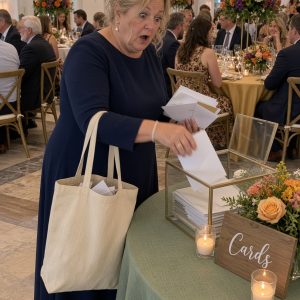
At her own wedding, her mother-in-law had taken the money. All of it. Stood at the gift table and cleared it into a handbag and called it repayment, in front of everyone, and Marguerite’s new husband had said nothing, and Marguerite had spent the first year of her marriage broke and humiliated and too ashamed to tell her own family. She had carried it for forty-six years. And at my wedding, watching a card box fill up, something old and broken in her had simply reached out and done to me the exact thing that had been done to her, as if collecting on a debt the universe still owed her.
She did not realize she was confessing. She thought she was telling a funny story about the old days. My mother let her finish, then said, quietly, “That must have been a terrible way to start a marriage.” And Marguerite stopped. You could see the sentence land. You could see her hear herself.
She gave the envelopes back the next morning. All of them, unopened, in a grocery bag, left on my mother’s porch with a note that said only I’m sorry. I didn’t know why I did it until Tuesday. That was the closest thing to self-awareness the woman had ever produced, and my mother had drawn it out of her with a roast and one question, without a single raised voice.
I wanted the fight. I wanted her named and shamed in front of the two hundred people who saw it. My mother knew something I didn’t, which is that a woman who steals a wedding is usually a woman something was stolen from, and that you cannot break that cycle by winning. You break it by being the first person in it who refuses to pass the wound along.
Marguerite and I are not close. But she has sat at my table many times in the years since, exactly as my mother predicted, and she has never once touched anything that wasn’t hers. Last year she gave my daughter a savings bond and told her, apropos of nothing, “Nobody takes what’s yours, sweetheart. Not ever.” My daughter didn’t understand it. I did.
My mother was right. I could have won that night. I would have spent thirty years enjoying the victory across a Thanksgiving table from a woman who hated me. Instead my mother handed a thief the one thing nobody had ever given her, which was the grace to see what she’d become, and it cost us a roast and an evening, and it bought a peace I did not think was possible.