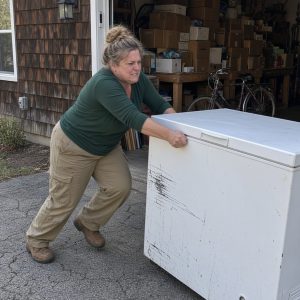
The loan application was the reason the padlock never really mattered. While I was smashing brass off my own refrigerator, the actual crime was already sitting in my inbox. Someone in my house had applied for sixty-two thousand dollars in my name, over my Wi-Fi, and it did not take long to work out who. Bennett was unemployed by choice, not by circumstance, and the gaming room he built in my office had a very good view of the drawer where I kept old mail with my Social Security number on it. He had the access, the time, and the motive, and the security data attached to the application pinned it to a device on my network.
I did not tell them what I knew that night. I let Bennett post his video of the crazy wife with the hammer, because I understood, standing in that kitchen, that the video was going to become the least of his problems. I froze my credit that evening, filed a report with the lender’s fraud department the next morning, and gave the police the application, the timestamps, and the router logs. A padlock on a fridge is petty. Identity theft is a felony, and it had been committed under my roof by the man his mother had been feeding out of my pantry.
Marcus was the part that broke me, and I want to be honest about it. He did not know about the loan. But when the detective laid it out, and Bennett’s device was confirmed, my husband’s first instinct was to ask whether we could “keep it in the family.” That sentence ended my marriage more completely than the padlock ever could. A man who wants to keep his brother’s felony quiet to protect his mother’s feelings is not a man who was ever going to protect me.
Bennett was charged. Cordelia was not, though the fraud referral named her as present in the household, and that was enough to end the “temporary” stay overnight. They were gone within a week, because a police investigation is a remarkable eviction notice.
The divorce was clean, because the house was mine, the down payment was mine, the remodel was mine, and there was no arguing with a deed. I kept everything, including the refrigerator, which I never replaced, because I like the small dents where the padlock used to hang.
For six weeks they treated my home as an occupation, my groceries as theirs to ration, my kindness as a door left open. Cordelia mistook my politeness for weakness and my silence for permission, and every week she pushed a little further to see how much I would swallow. She wanted the hammer. She wanted proof I could be provoked into looking unhinged. What she never once imagined was that the quiet woman who hated scenes had already seen the credit alert at lunch, and knew exactly whose felony was hiding behind her petty little padlock. The fridge was never the notice. The notice was that I had stopped being someone they could take from, and started being someone who keeps the receipts.