The invitation came on thick cream paper, elegant and expensive, just like everything my mother-in-law Margaret loved. Her sixtieth birthday was a private restaurant, dozens of guests, silk gowns, and wine that whispered wealth. We did not belong there. Most of what I earned went to therapy for our eight-year-old son, Liam. I could not arrive empty-handed, so I spent weeks knitting her a sweater in deep emerald wool. One sleeve was slightly tighter than the other. It was warm and made with care. When I handed it to her, she opened it slowly. Then, louder than necessary, she asked if this was what poverty looked like. My son earns money, she said, and I waste it. Could I not buy a normal gift instead of giving people trash? The room went quiet. Beside me, Daniel said nothing. Not a word. Not even a glance.
The rest of the evening passed in a blur. An hour later a housekeeper said Margaret wanted to see me in her room. I thought it would get worse. Instead the sweater was hanging on a rack in her wardrobe, smoothed out and treated like something valuable. Sit down, she said, and her voice was different. She had never meant to hurt me. She wanted her son to feel ashamed. She knew about Liam and the therapy. She had spoken to Daniel many times. He refused to take responsibility. He said our child was my problem. The therapy bills I thought he paid had come from her. She had hoped that if she pushed him hard enough tonight, he would finally defend me. He did not. That was when she realized she had failed raising him.
She placed a small envelope in my hands. Inside was a bank card, an emergency fund for Liam and for me. I shook my head. She said I could and I would. She would support me until her son became a real man, and if he did not, she would support me after the divorce too. She would not fail me. In that moment everything I thought I knew about her shifted. She was not cruel. She was desperate to fix what she could not undo.
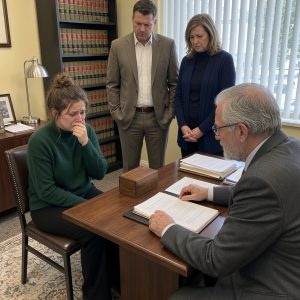
Months later I stood in a courtroom. Daniel sat across from me, distant and unmoved. I was not alone. Margaret sat beside me, calm and steady, the sweater I had made wrapped around her shoulders. When the judge finalized the divorce, grief and relief arrived together. Outside she reached for my hand. She was not losing a daughter-in-law. She was choosing a daughter.