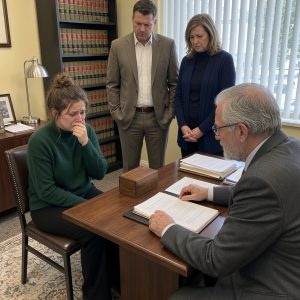
In my college literature class she sat in the front row every day. Her posture was straight, her notebook open, her handwriting neat and deliberate. She never whispered, never fidgeted, and answered the professor’s jokes with only a polite smile that faded before anyone could hold it. While the rest of us shifted and checked our phones, she listened. We assumed she was painfully shy. A few called her weird. In the comfortable self-absorption of college, none of us wondered much further than that. Her silence became part of the room, like the clock or the hum of the lights.
It happened on a gray Thursday. Mr. Anderson was discussing *The Great Gatsby* and no one wanted to analyze symbolism before nine. He paced and demanded an opinion on the final line. When no one spoke, his eyes fell on her. She had been there every class, always listening, always taking notes. Don’t just sit there like a statue, he said. Did no one ever teach you how to speak? The words landed harder than he meant them to. She stood, walked to the front, and picked up a marker. Without a sound she wrote, “I lost my voice in an accident two years ago.” Then, beneath it: “But that doesn’t mean I have nothing to say.” She underlined the last sentence and added one more: “Most people don’t ask. They just assume.” She put the marker down, returned to her seat, and opened her notebook as if nothing had happened.
His face went from confusion to shame. He apologized, then told the class they spent so much time learning how to talk that they forgot how to listen. From that day he kept a marker at her desk and made room for written and nonverbal answers. We learned her name was Lydia. A car accident had damaged her vocal cords; doctors said they might never heal. She had come back determined to finish her degree, typing questions on a tablet and carrying laminated cards for emergencies. She did not want pity. She wanted understanding. Some of us stayed after class to write notes or learn basic signs. The room grew quieter on purpose. People listened with their eyes. Conversations slowed and became deeper.
Her essays were clear and alive. In one she wrote that silence is not absence, but presence without noise. On the last day she arrived early and wrote on the board, “Thank you for listening. It means more than you know.” No one erased it. We had assumed she was shy, that she had nothing to say, that silence meant weakness. We were wrong. She did not set out to teach a lesson. She showed us that empathy begins where assumption ends, and that a voice is not only sound. It is presence, truth, and the courage to show up in a world built for noise.